
Project Overview
AI Photo Enhancer App represents an intelligent photo editing solution designed specifically for the use of a professional photography studio based in the USA. The main idea was to automate photo editing using the power of artificial intelligence, so that the studio could improve its large volumes of photographs while preserving the same level of quality.
Prior to the implementation of the AI app, the studio used to manually edit all their photographs. The processes like skin retouching, color adjustment, lighting, and background enhancement took much time and resources to complete.
Therefore, in order to help the studio save on time and expenses and speed up the photo editing process, we built an application that uses AI and machine learning algorithms to perform all these processes automatically. The technology stack includes React, Node.js, TensorFlow, Python, AWS. If you are looking to build a similar intelligent solution for your business, you can hire dedicated developers from our expert team to bring your vision to life.
Project Objectives
- Save time on editing photographs through automation and machine learning.
- Save time on editing large numbers of photographs through automation.
- Enhance the quality of images by means of automatic color adjustment.
- Make the photo editing process easy for employees with an easy-to-use interface.
- Keep the style of photo editing consistent for portraits, weddings, and commercials.
- Process and store photos in the cloud in a safe environment.
- Save time and money through reduced editing needs.
- Enhance customer satisfaction by delivering photographs faster.
Let's Shape Your Project Together
Have an idea, a challenge, or a new project in mind? Our team is here to help.
Business Challenges
1. Time-Consuming Manual Photo Editing Process
Manually editing photos included processes like color corrections, retouching, light modifications, and background improvements. It took a lot of time for the photo studio to process each photo manually, hence preventing the team from taking on more customers’ jobs.
2. Slow Photo Delivery at Peak Times
Large numbers of photos were created through wedding photo shoots, portrait shoots, and commercial photography projects that required quick editing and submission. However, the process used was very time-consuming, such that it took four to five days to deliver.
3. Expensive Photo Editing Process
It is quite costly to have a big team of photo editors because it increases operational costs. Additionally, as the amount of work increased, it was hard to balance costs, efficiency, and productivity.
4. Ensuring Image Consistency in Quality
The combination of different editing approaches and manual methods might create variations in colors, skin tone, lighting, and even the quality of the images themselves. The client required an intelligent tool that would enable him to repeat edits while maintaining a professional look of the pictures.
5. Complicated AI Operations and Image Quality Requirements
The creation of an AI photo editor went beyond applying automated filters. The tool had to process images with different sizes, formats, and styles while maintaining quality and enabling bulk operations.
6. Image Privacy and Data Security
Professionals who run photography studios work with confidential photographs, including portraits, wedding pictures, and commercial ones. It was important to ensure the privacy of customer images throughout the process of uploading, processing in the cloud, storing, and downloading.
Our Solutions
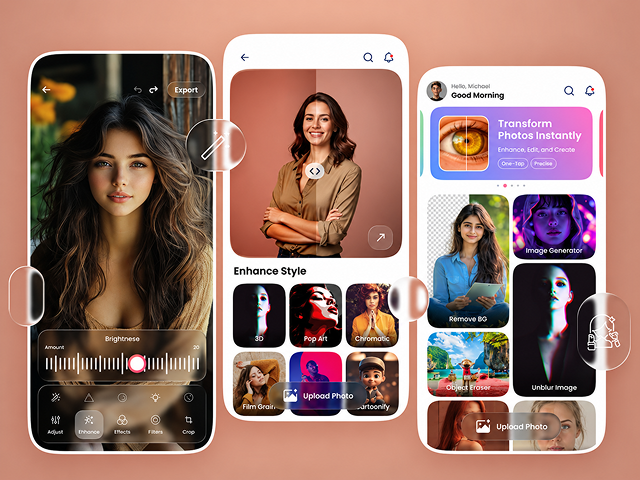
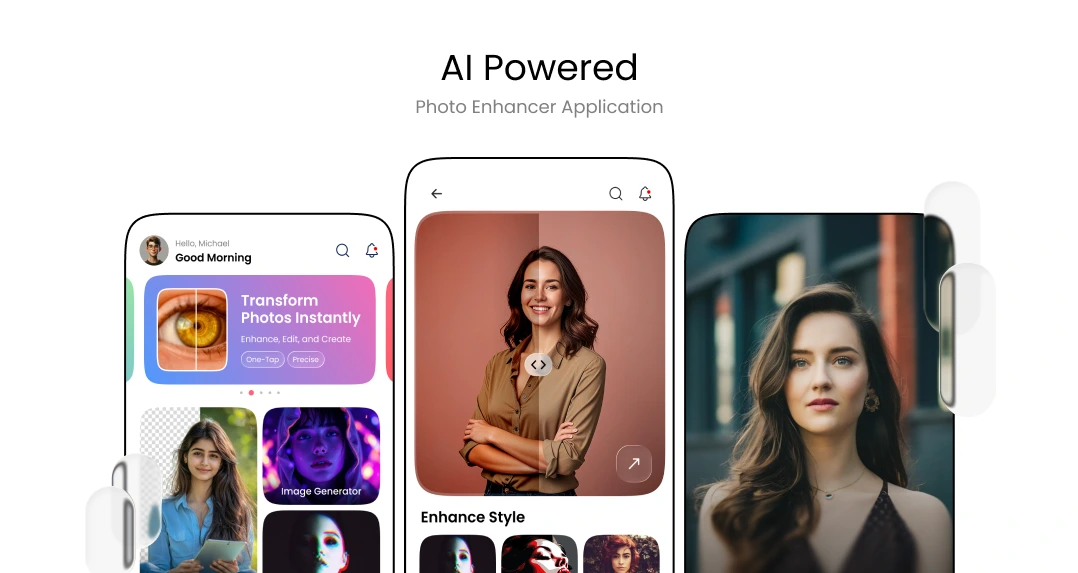
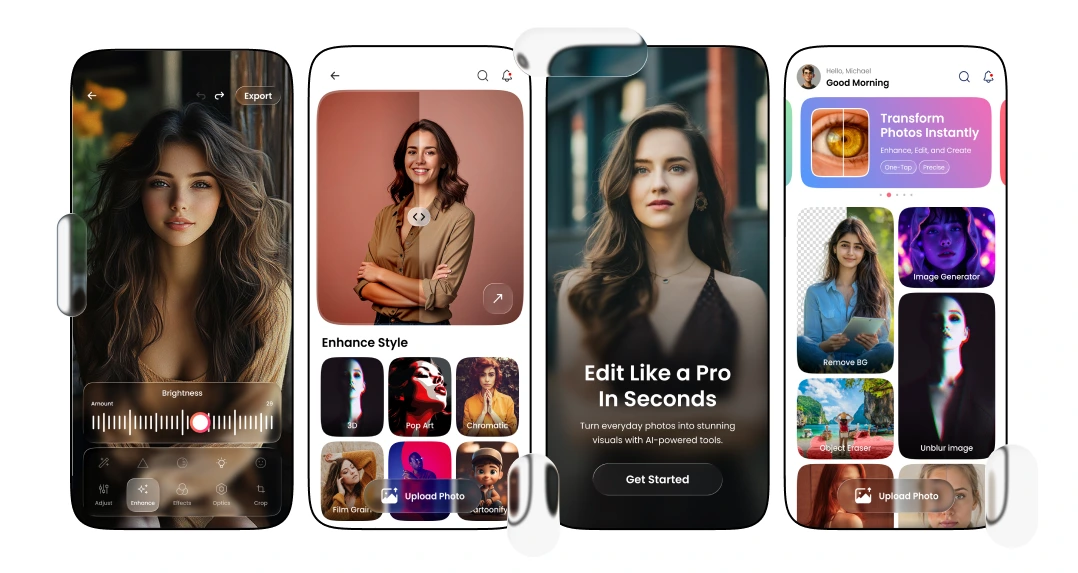
With the aim of addressing the problem of editing delays for the photography studio, an innovative AI Photo Enhancer App was created, enabling automatic photo enhancement and simplifying the entire editing process. This app features AI-based photo editing capabilities, bulk uploading of photos, flexible editing styles, as well as safe cloud-based storage.
As an experienced mobile application development company, our team focused on building a practical, easy-to-use solution that balanced intelligent automation with the flexibility professional photographers need.
AI-Driven Automated Photo Enhancements
AI-based image enhancements were integrated into the solution to automate such tasks as color correction, adjustment of lighting conditions, face retouching, blemishes elimination, and other image improvements. Deep learning models were trained on a high-quality sample of before-and-after photographs provided by the client. This solution helped to eliminate repetitive tasks and allowed the studio to process photographs faster without relying completely on manual editing.
Process Multiple Photographs Faster
Multiple photo upload and batch processing feature allowed the studio to process hundreds of images within one workflow. Users were able to process many photographs at once instead of working with each photo individually. The ability to process multiple photos at once was especially useful during intensive seasons.
Ease of Work with the Intuitive UI
An intuitive user interface was designed in React and Tailwind CSS in order to make it convenient for photographers who have different levels of expertise in technology. Users can upload photographs, choose enhancement parameters, see the results of their work, and manually edit automatically generated images.
Enabling Secure Image Processing on the Cloud
To facilitate scalability and efficient processing of a large volume of images, cloud computing services such as Amazon Web Services were used alongside the capabilities provided by cloud storage. These were supported by security features including encryption through the use of HTTPS and watermarking capabilities, among others.
Key Benefits
- Utilize artificial intelligence to automate routine photo editing processes.
- Cut down the time taken to edit images and speed up photo delivery.
- Upload and process multiple photographs at once.
- Ensure uniform quality across wedding, portrait, and commercial photography.
- Adjust automated edits to meet specific project needs.
- Allow easy operation for photographers of all skill levels.
- Safely handle and protect client photographs in the cloud.
- Minimize post-production expenses and optimize studio performance.
Key Features
Enhancement of Images by Using AI Technology Effortlessly enhance image quality using AI-powered methods that can help eliminate manual editing efforts.
Automatic Image Adjustment Correct the colors, lighting, shadows, and contrast to achieve better-quality photographs.
AI-Based Retouching of Faces Helps retouch the skin by eliminating blemishes and improving facial details with a professional look.
Batch Loading and Processing of Images Helps upload and process many images at once in order to simplify the process of managing large numbers of images for photography studios.
Preset Styles for Editing and Photographing Use preset styles for editing and photographing for wedding, portrait, and commercial purposes.
Manual Editing Options Check the AI-edited photos and apply further edits before saving the edited photo.
Preview of Before and After Images View the original photo along with the enhanced photo in order to see the effect of your edits.
Cloud Storage Integration Facilitate image importing and exporting by integrating cloud storage systems, such as Google Drive and Dropbox.
Security and Watermarking of Images Protect your image assets with proper download security and watermarking.
User Accounts Creation Let users sign up to the application via their email ID or cell phone number to access editing features.
Scalable Cloud Infrastructure Utilize AWS cloud computing services to handle increased image processing workloads.
Technology
| Frontend | React, Tailwind CSS |
| Backend | Node.js, Express.js |
| AI/ML Frameworks | TensorFlow, Python |
| Cloud Infrastructure | Amazon Web Services (AWS) |
| Storage Integration | Google Cloud Storage |
| Third-Party Integration | Dropbox API |
| Image Processing | Pillow, scikit-image (Skimage), Dlib |
| Security | HTTPS, Secure Authentication |
| Application Type | AI-Powered Photo Enhancement Application |
Business Results
70%
Reduction in Photo Editing Time
AI-powered enhancement and bulk image processing reduced the time required for photo editing, helping the studio handle larger workloads without relying entirely on manual workflows.
24–48 Hours Faster Photo Delivery
The studio improved its delivery turnaround from approximately four to five days to 24–48 hours, enabling customers to receive their edited photographs sooner.
66%
Customer Satisfaction Improvement
The project reported a 66% customer satisfaction result associated with professionally enhanced photographs. This figure reflects the reported outcome and should not be interpreted as a 66-percentage-point increase without supporting survey data.
Reduced Need for Additional Editing Staff
Automating repetitive editing tasks helped the studio manage bulk photography projects with fewer additional editing resources, supporting better control over operating costs as demand increased.
Improved Bulk Processing Capacity
The application enabled the team to enhance hundreds of photographs in minutes, improving workflow efficiency and helping the studio accommodate more customer projects during peak seasons.
Product Gallery


Are You Interested in Creating a Similar App for an Image Quality Booster?
Our consultants are ready to hear your ideas. Request a free consultation with our software & app experts and transform it into a digital reality.
- 450+ Engineers
- 14+ Years
- Flexible Engagement
- US Business-Hour Collaboration
Frequently Asked Questions
An AI Photo Enhancer App is an application that improves photos using artificial intelligence and image processing technologies. Depending on its capabilities, it can accomplish several functions, including color correction, lighting correction, face retouching, and other processes to improve the image.
AI photo editing enables photography studios to edit large sets of photos quickly, retain consistent editing styles, save time on repetitive tasks, and provide clients with their photos faster.
Yes, this feature has been included in the development of this photo editing AI app.
React and Tailwind CSS have been used in the frontend part, while Node.js and Express.js have been used for the backend development of this application. TensorFlow and Python have been used for the AI/ML capabilities, and AWS has been used for cloud technologies.
The app makes photo editing faster due to automation of repetitive processes such as color correction and facial retouching, as well as bulk processing of photos. The project achieved a 70% reduction in photo editing time.
Yes. Manual editing options enable users to edit the results of AI processes manually in order to get the desired photograph.
The project has several protection measures, including HTTPS connection, secure authentication, and watermarking. Security of the image is crucial during its transfer, processing, storage, and delivery.
Yes. The project includes the possibility of cloud storage integration that can use Google Cloud Storage and the Dropbox API.