

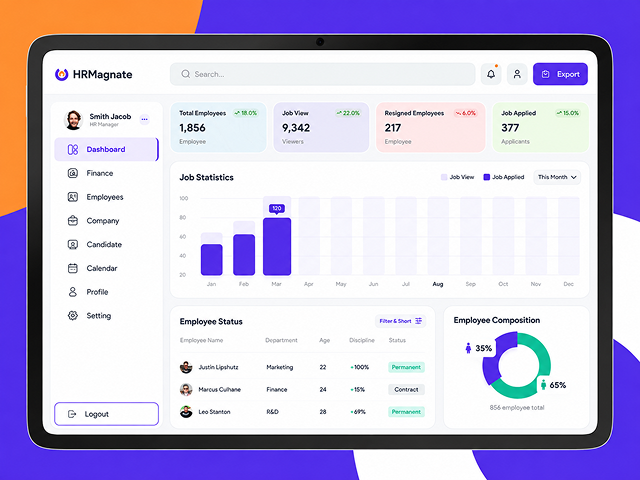
Project Overview
The Human Resource Management System (HRMS) is a tailor-made software system designed to assist organizations in managing the complete lifecycle of employees from hiring and onboarding to attendance, payroll, performance management, and exit procedures.
Our client, a mid-size IT and telecom solutions firm with more than 250 employees, required a state-of-the-art HRMS to replace the old HR software and automate most of the manual processes. The records of employees, attendance, documentation, and approval processes were scattered among various systems, causing problems for the HR department to carry out its operations smoothly.
We have built a centralized HRMS with an easy-to-use admin panel and employee self-service portal. The system brings all the HR-related processes under one umbrella, automates the workflow processes, and increases visibility into the records of employees.
Project Objectives
- Employee information should be centralized in one place.
- Onboarding and document management should become simpler.
- The process of attendance tracking and leaves should be automated.
- Make the process of payroll processing faster and minimize mistakes in attendance tracking.
- Enhance employee performance management with the help of project KPI and reviews.
- A self-service portal for both employees and managers is needed.
- Integration of HR functions with ERP and other business systems is important.
Let's Shape Your Project Together
Have an idea, a challenge, or a new project in mind? Our team is here to help.
Business Challenges
1. Fragmented Management of Employee Data
The employee’s personal data, certificates, attendance records, and other HR documents were scattered in various systems and folders. Searching for the historical data and keeping track of the employee’s records was an extra task that had to be performed. The customer needed a single database where all the employees’ data would be located.
2. Manual Onboarding and HR Processes
The current system involved lots of paperwork and data entry when new employees joined the company. HR department had to collect, check, and approve all the necessary documents manually. It slowed down the process of onboarding and made it hard to handle an increasing number of employees.
3. Attendance and Payroll Mistakes
Collecting attendance data for both office-based employees and field engineers and technical support specialists posed additional difficulties. Manual attendance data collection could lead to mistakes and problems with payroll processing.
4. Ineffective Leave and Approvals Administration
Employees and managers did not have one platform for tracking their leave applications and holidays, which led to unnecessary checks and delays.
5. Poor Performance and Employee Visibility
The client needed an effective solution to analyze employee performance compared to project goals and KPIs. The absence of centralized performance tracking and analysis meant extra work was needed in order to review employees’ performance and identify necessary training.
6. Lack of Integration of Business Systems and Reporting
Information about employees was scattered across old HR software and other business systems. It was hard to link HR data with finance and operations. The client needed a more integrated system with secure access and HR analytics.
Our Solutions
In order to overcome these difficulties, we have devised Centralized Human Resource Management Software that integrates information about the employees, their attendance, onboarding process, payroll processing, leaves, and appraisal of performance in one system.
Being a custom software development company, we started by getting acquainted with the HR process in place at the customer’s end and determining how automation can help cut down on repetitive tasks. We used the iterative development model, made wireframes, and created a modular solution based on the current and future needs of the customer.
The solution consists of two main interfaces: one is for HR, and the other is a self-service portal for employees. We also considered workflow aspects such as approval hierarchy, notifications, and access control to simplify HR-related tasks.
Centralized Employee and Document Management
We have created a centralized employee database to arrange employee profiles, contact information, employment information, certificates, and other necessary documents. HR teams will find it easier to access the employee database, while authorized employees can use the portal to view and manage their personal information supported by the system.
It will decrease dependence on various spreadsheets and shared documents and make the process of managing employee information more convenient.
Automated Onboarding and HR Workflows
HRMS will provide digital onboarding through the online filling of forms, submitting documents, and the approval process through built-in notifications and workflow triggers. HR teams will be able to coordinate onboarding tasks and handle standard requests in an automated way. We also automated the process of leave applications and other recurring HR processes.
Attendance and Payroll Workflow Management
We integrated the feature of attendance management to enable the organization to keep records of employee attendance and assist with payroll processing. This was done in a manner that would allow the system to meet the needs of the client’s employees working in both office and field settings.
Employee Self-Service Portal
We created a portal for employees where the employees can have access to the HR services provided via the portal. Employees would be able to access leave information, payslips, training schedules, relevant documents, and make requests without having to approach HR for everything.
Performance Management and HR Analytics
The solution is capable of performance review and KPI tracking to enable managers to measure the performance of employees against certain objectives. HR departments can leverage central data for performance evaluation, training needs, and record-keeping for employee development. Reporting and analytics capabilities will also assist management in reviewing attendance, workforce, and HR activities.
Business System Integration and Secure Access
The solution was built to integrate with the client’s ERP and telecom project management systems, thereby minimizing information gaps between HR, finance, and operations.
Role-based access control and auditing provide secure access to employee data. The solution was also built to meet regional compliance requirements depending on the client’s business and deployment requirements.
Key Benefits
- Employee information should be centralized.
- Reduce paperwork by implementing online onboarding and document management.
- Improve attendance and payroll processing.
- Make leave management and holiday planning easy.
- Allow employees to use HR services.
- Understand employee performance and project KPIs.
- Avoid repetitive HR processes through workflow automation.
- Integrate HR information with relevant business applications.
- Provide secure access to employee information.
- Grow your workforce with an HR management system.
Key Features
Digital Onboarding for Employees
Make it possible for employees to digitally fill out onboarding forms, upload necessary documentation, and go through verification and approval processes.
Employee Profile and Database Management
Maintain the profile and employment information, certificates, and other HR documents in one centralized database.
Attendance Management and Mobile Check-ins
Keep track of attendance of office and field employees using supported attendance processes. Geofencing and biometrics can be used to confirm attendance when appropriate configurations are in place.
Payroll Management Assistance
Manage attendance and employee data needed for payroll generation to ensure fewer manual reconciliations and more accurate data.
Employee Performance and Project KPIs Monitoring
Keep track of employee performance against set objectives and KPIs for projects.
Employee Self-Service Portal
Allow employees to use supported HR services such as leave details, payslips, document management, training calendar, and service requests.
HR Workflows Automation
Automate routine HR operations using configured approval hierarchies and notifications.
Employee Leave and Holiday Management
Allowing staff to make applications for leave and have access to information about it; at the same time permitting managers and HR departments to check those applications.
ERP and Other Business Systems Integration
Integrating HR processes with the client’s ERP and Telecom Project management systems depending on the interfaces and integrations required.
Compliance and Access Control
Offering the capability of granting access to employee information through role-based access and logging all of the related system activities to keep track of them.
HR Training and Development Management
Helping HR departments to manage employee training information and certification details to know about the employee progress.
HR Analytics and Reporting
Providing reports and dashboards on Attendance, employee records, and other relevant HR information.
Technology
Business Results
60%
Improved HR Process Efficiency
Digital onboarding, centralized employee records, and automated approval workflows reduced paperwork and manual effort. According to the project notes, routine activities such as onboarding and leave approvals could be completed within a day.
35%
Reduced HR Team Workload
The employee self-service portal and centralized HR dashboard reduced the need for HR staff to handle routine employee inquiries manually, allowing the team to focus on more important workforce activities.
90%
Fewer Payroll Complaints
The original project report stated that 90% of payroll complaints were resolved through improved attendance accuracy and reduced manual reconciliation. This helped address common issues associated with incorrect attendance records and payroll preparation.
100%
Digital Employee Record Management
Employee records, documents, and approvals were digitized and stored securely in a centralized system, reducing dependency on scattered paper records and disconnected storage locations.
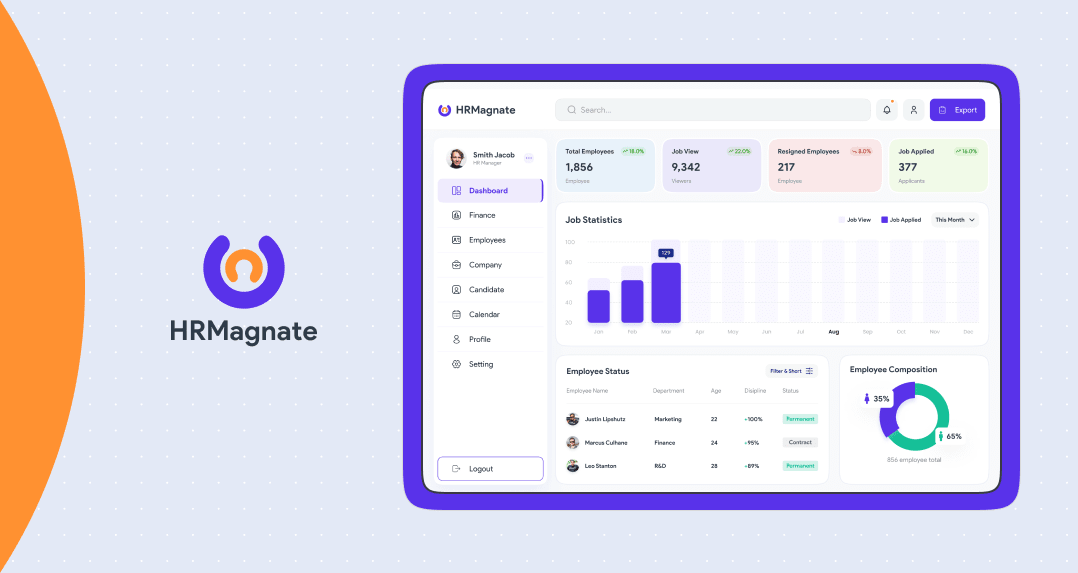
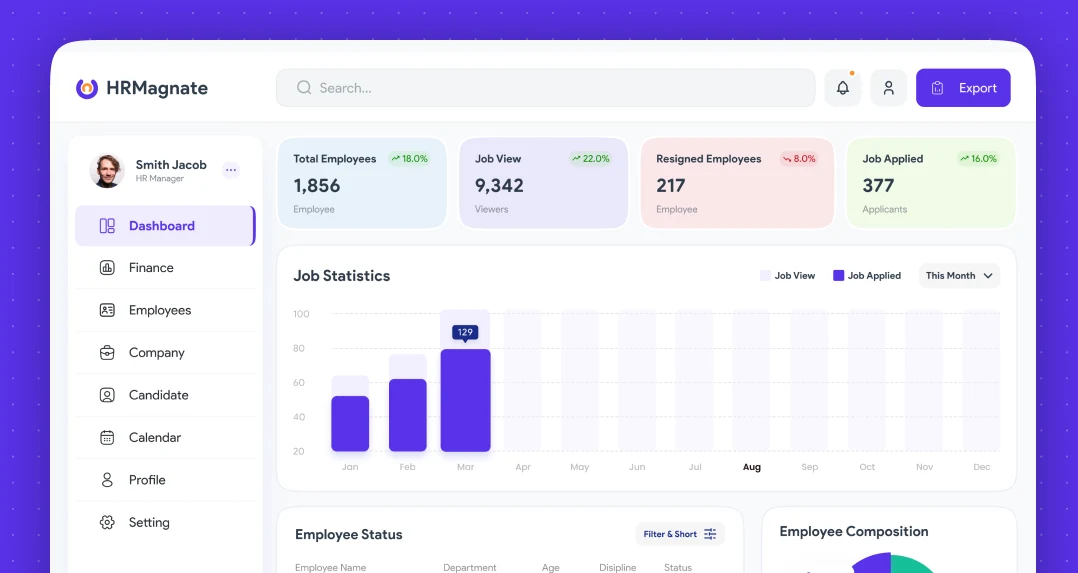
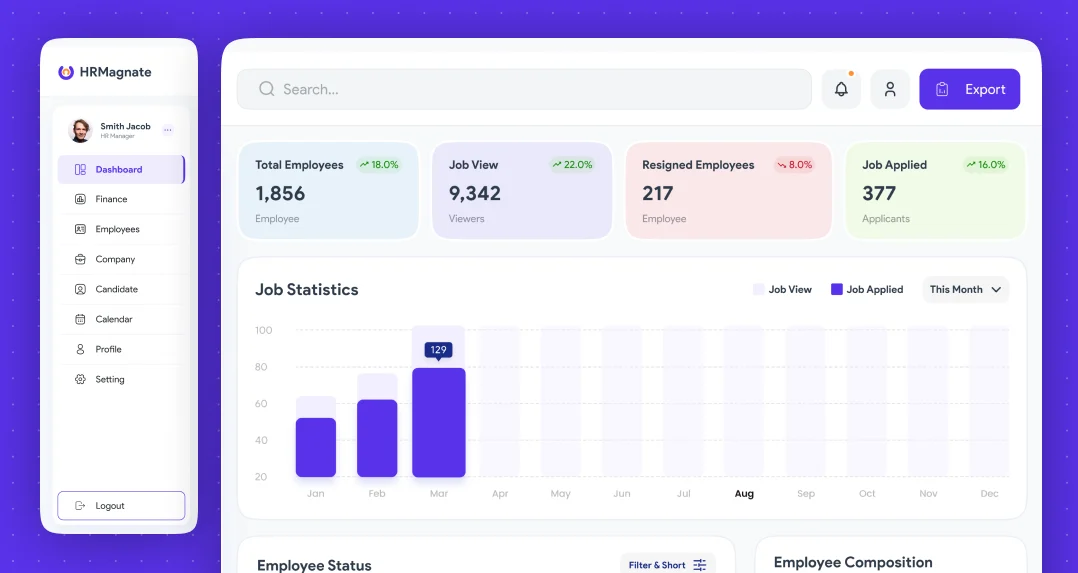
Product Gallery
Are You Interested in Developing Similar Human Resource Management Software?
Managing employee information across spreadsheets and outdated systems can slow down HR operations as your business grows. A custom HRMS can help bring employee records, onboarding, attendance, leave management, and performance reviews into one organized platform.
- 450+ Engineers
- 14+ Years
- Flexible Engagement
- US Business-Hour Collaboration
Frequently Asked Questions
Human Resource Management Software is a computer-based system that helps in managing employee data, employee onboarding, attendance, leave, payroll, performance reviews, and many other HR-related processes through one system.
The important components of the HRMS solution include digital onboarding, employee profiles, attendance management, leave and holidays management, payroll workflow management, performance reviews, employee self-service, HR workflow management, reporting, and access management.
Yes. The HRMS helps in automating the onboarding process by digitizing the onboarding forms, collecting documents, approving documents, and handling other onboarding processes.
Yes. Depending on the availability of APIs in the client company, the integration of HRMS with the existing payroll and ERP system can be done.
Through an employee self-service portal, employees get the facility to access their HR information, submit leave applications, download payslips, and make service requests.
Yes. Depending on the HRMS system, attendance management can use mobile check-ins, geo-tagging, and biometrics integration, among others.
Provided that an HRMS system is used in the right way, the safety of the data can be guaranteed by means of such tools as role-based permissions, authentication, auditing, and restricted access, among others. The rest depends on the organization’s needs.
The cost will depend on the number of modules, number of employees, integrations, reporting, platform compatibility, security, and deployment options. Above all, you should define your basic requirements.