

Project Overview
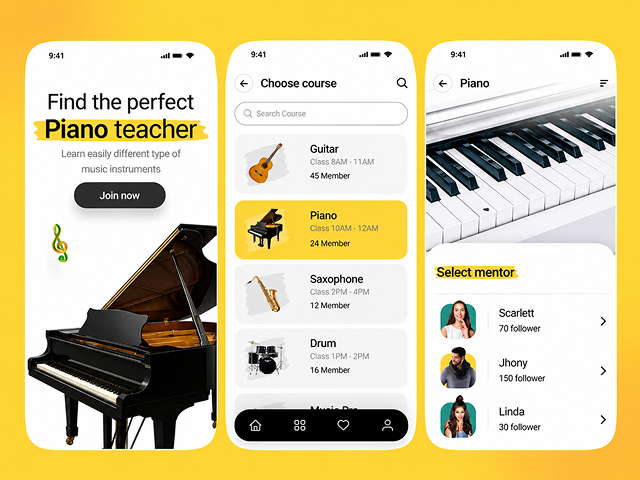
Our company created a Piano Learning App for a USA-based music school that had a desire to provide piano lessons to students not only in classrooms but outside of them. Our task was to bring traditional music classes and mobile technologies together and let learners study on their own and get personalized assistance at the same time.
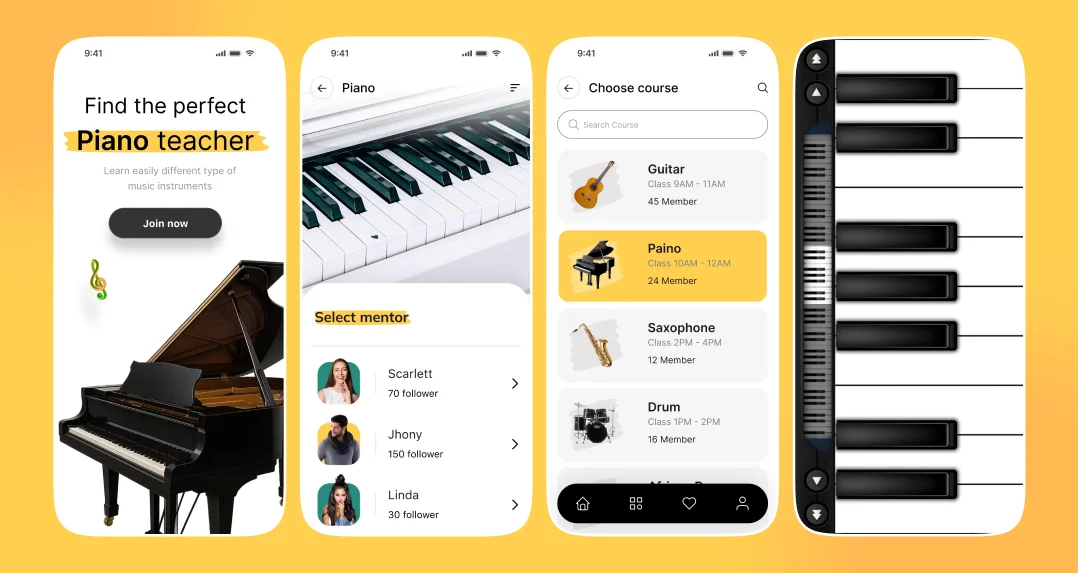
It provides users with interactive piano classes, videos from an instructor, live play feedback, AI analysis of the user’s play, and gamified tasks. Users may practice musical notes, chords, rhythm, intervals, and also monitor their learning process.
Built with Flutter, the application provides a cross-platform mobile experience that is complemented by backend services and cloud-based components and includes features such as practice notifications, achievements, and also teacher-student communication.
This solution helped the school to extend its range of digital education services and find new ways of generating additional income.
Project Objectives
- Make piano classes available for people who learn from afar.
- Provide personalized and engaging musical instruction.
- Give learners feedback on their piano performance.
- Facilitate regular learning through gamification and reminders.
- Enable instructors to keep track of learner progress and completed classes.
- Make music theory and ear training easier with interactive tutorials.
Let's Shape Your Project Together
Have an idea, a challenge, or a new project in mind? Our team is here to help.
Business Challenges
1. Limited Availability of Piano Classes
Most classes were conducted on a personal basis, meaning that it was difficult for the students who were living beyond the vicinity of the institution to attend classes. Mobility and availability of classroom spaces posed problems in ensuring regular attendance.
2. Inconsistency in Practicing
A number of the students had problems maintaining consistency in practicing their skills between lessons. The academy required ways through which it can motivate the young generation to practice effectively.
3. No Immediate Feedback on Practice
When students practiced on their own, it was quite difficult for them to realize the errors they made in timing, note accuracy, and rhythm. It meant that progress would be slowed down in the absence of immediate feedback from instructors.
4. Challenges in Following the Development Process
It was difficult to follow the progress of individual students during independent practice sessions. The instructors needed a systematic approach in following up the development process of the students.
5. Making Music Theory Fun
New students may have difficulties comprehending musical notes, intervals, rhythm, and other symbols. The goal of the academy was to make these subjects easy for students to comprehend via exercises, audio tasks, and games.
6. Extending Digital Education Opportunities
The client desired a modernization of the education process while keeping the interaction between the teacher and the student. It could be achieved by introducing a scalable mobile application, which would bring new opportunities and online courses.
Our Solutions
In this project, Our Dedicated development team has designed an interactive Piano Learning App that integrates guided lessons, feedback provided by an AI-based tool, learning progress monitoring, and gamification. Our solution allows students to learn individually while giving teachers insight into their progress.
As a top Flutter app development agency in the USA, we used Flutter to build a cross-platform app for Android and iOS so that learners can easily access piano lessons.
Interactive Piano Lessons
We have developed structured lessons focused on musical notes, chords, rhythms, and fundamentals of piano playing. Visual exercises and guided lessons help students conduct themselves in their lessons. We have created an introductory onboarding that helps beginners use the application.
AI-Assisted Performance Analysis
Our application uses an AI-assisted performance analysis feature to help students assess the quality of supported inputs for piano playing and find opportunities for improvement. Feedback related to aspects such as timing and note accuracy makes self-practice more effective and gives extra advice for lessons not conducted by a teacher.
Gamified Learning Environment
We have added interactive lessons, achievement badges, and milestones to motivate students to do exercises and be proud of their achievements.
Progress of Students
The application helps in tracking the practice progress, completed lessons, and general learning progress. It enables the students to keep track of their development and allows the instructors to have the necessary data on what requires attention.
Instructor Videos and Communication
Students have access to instructional videos recorded by academy instructors. They can refer back to them when they need to. Teacher-student messaging enables the communication and discussion of learning problems outside of class hours.
Music Theory and Ear Training
We have introduced exercises based on musical intervals, notes, rhythm, duration of notes, and music symbols. Spelling, melodic intervals, and harmonic intervals will enable the students to build a strong musical foundation.
Practice Smart Reminders
Practice reminders help the learner come back to the lessons. Together with practice, progress tracking, and achievements, reminders help the learner establish a consistent practice routine.
Mobile Development Across Platforms
With the use of Flutter and the Dart programming language, we have created a mobile app that runs across different platforms and uses such technologies as Node.js, Express.js, Firebase, and Firestore. Google Cloud Platform and Firebase Analytics provide relevant cloud services and application analytics.
Key Benefits
-
Take piano classes beyond physical classrooms.
-
Provide mobility and flexibility in the learning process.
-
Motivate learners to practice using reminders and rewards.
-
Enable learners to detect performance issues using artificial intelligence feedback.
-
Make music theory easy using interactive learning modules.
-
Monitor practice sessions and completion of lessons.
-
Enhance interaction between teacher and student.
-
Provide access to tutorial videos created by instructors.
-
Allow online courses and subscriptions.
-
Contribute to the digital growth of the academy using an application.
Key Features
Interactive Piano Lessons
Step-by-step lessons will teach students the basics about notes, chords, rhythm, and piano lessons.
Playing Feedback
Give real-time feedback on supported performance data to assist students in detecting mistakes while practicing.
Performance Analysis Using Artificial Intelligence
Assess performance data using AI assistance and provide guidance for improvement in timing and note playing.
Gamification of Learning
Introduce practice tasks, milestones, and achievements to motivate students to participate.
Student Progress Monitoring
Check on practice activity and completed lessons to help students track their progress.
Video Tutorials by Instructor
Allow students to watch video instructions and repeat the lesson when they need to.
Practice Reminders
Notify students to promote good practice habits.
Teacher-Student Chat
Facilitate communication between the learner and the instructor.
Skips, Steps, and Intervals
Learn about distances between notes and steps over the keyboard.
Interval Recognition and Ear Training
Teach students how to distinguish pitch relations.
Games for Spelling and Notation of Music Symbols
Enhance comprehension of notation and musical terms using games.
Duration and Rhythm Exercises
Utilize visual and auditory activities to develop your rhythmic skills.
Ear Training Exercises
Enhance your listening skills through exercises on unisons, fourths, fifths, octaves, and other pitch-recognition exercises.
Onboarding Guidance
Guide new users through the learning process of the application.
Cloud-Connected Services
Enable application data and activities via cloud technology.
Technology
| Mobile Development | Flutter |
| Programming Language | Dart |
| Backend | Node.js |
| Backend Framework | Express.js |
| Database | Firebase, Cloud Firestore |
| AI/ML Integration | TensorFlow Lite |
| Cloud Services | Google Cloud Platform |
| Analytics | Firebase Analytics |
| UI/UX Design | Figma, Adobe XD |
Business Results
40%
Increase in New Student Enrollments
The mobile learning experience helped the academy reach students beyond its traditional classroom audience, contributing to increased enrollments.
33%
Improvement in Learner Engagement
Interactive lessons, gamified exercises, and achievement-based learning made piano practice more engaging and encouraged students to participate actively.
New Revenue Opportunities Through Digital Learning
Online subscriptions and virtual courses created additional opportunities to expand the academy’s services beyond in-person teaching.
29%
Increase in App Downloads
The flexibility to access lessons remotely helped attract more users and increased adoption of the academy’s digital learning platform.
Product Gallery
Build Your Own Piano Learning App
Want to create an interactive music learning platform or an AI-powered piano tutor? Whether you want to scale up your internal engineering squad or hire a remote programmer to build custom audio-processing modules, our team can help turn your idea into a practical digital solution.
- 450+ Engineers
- 14+ Years
- Flexible Engagement
- US Business-Hour Collaboration
Frequently Asked Questions
A Piano Learning App is an app that teaches users piano playing using guided lessons, interactive exercises, theory of music, progress tracking, and performance analysis.
Usual features of such applications include interactive lessons, instructor videos, reminders about lessons, tracking progress, gamification elements, theory of music exercises, and performance analysis. Additional features may include AI assistance and ear training.
AI-assisted analysis can help to analyze supported performance inputs and give feedback on its rhythm and note precision. This analysis’ efficiency depends on the quality of input data and the capabilities of analysis algorithms.
Yes, mobile lessons, instructor videos, progress tracking, and communication between teacher and student enable music academies to teach students remotely from physical classes.
Flutter technology allows building cross-platform mobile applications, while Node.js and Express.js can build backend services. Firebase, Firestore, and TensorFlow Lite can provide application data and machine learning capabilities.
The cost depends on the app’s features, platforms, backend requirements, audio processing, AI integration, and subscription functionality. Read our guide to mobile app development pricing for more information.